Welcome to the LumiGeek gallery pages. Prior to founding LumiGeek in the beginning of 2013, JoeJoe Martin and John Parts Taylor worked individually and together on a multitude of LED and physical-computing projects. It was these projects that inspired us to form LumiGeek and share our LED technology with the world.
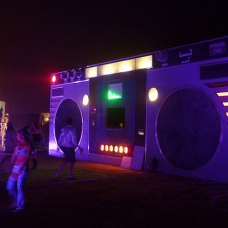
The Giant Boombox by Brass Tax was a 30′ long by 12′ tall structure that housed a massive sound system at Burning Man 2009.
The facade of the boombox had real-time servo-driven VU meters, real-time EQ lights, DMX driven mood-lighting, and a custom RFID entry system for the DJ booth and green room.
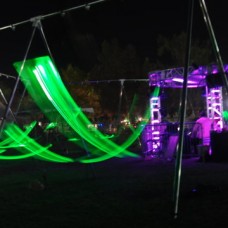
A collective of artists and fabricators from Austin, Texas wanted to create a highly interactive swing set. JoeJoe Martin created a custom PCB with an accelerometer, a wireless transceiver, and several LEDs. A small battery pack would provide motion reactive light throughout the evening. The swing set boards could also be controlled by a DMX lighting board, by way of a MaxMSP patch.
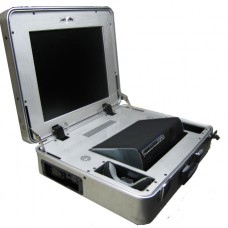
Prior to founding LumiGeek, Joe Martin and John Taylor collaborated on several design projects for Red Bull. The Xcase, an Xbox gaming system in a customized Zero-Haliburton briefcase, is a perfect example. Designed by Corbett Griffith and John Taylor, the portable gaming system included custom audio and LED hardware from Joe Martin.
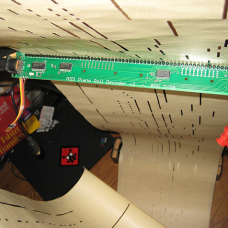
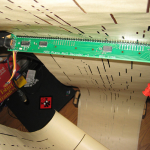
This custom technology was created for an automated jug-band instrument that was never finished by the artists.
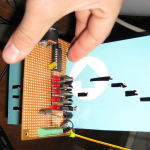
An array of infrared LEDs and detectors were used to generate MIDI signals. Another circuit board then translated these MIDI notes into triggers for relays/solenoids for a blast of compressed air.
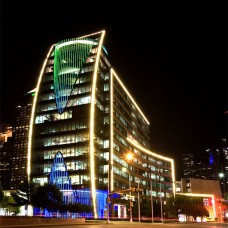
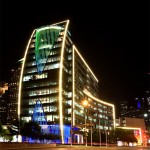
As freelance contractors prior to forming LumiGeek, John Taylor and Joe Martin were brought in to project manage an installation of over one linear mile of Element Labs VersaTubes on the facade of the Hunt Building in downtown Dallas.
The system contains over 90,000 individually controlled LEDs.
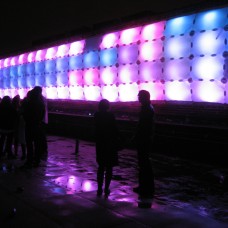
As part of the Red Bull Ascension event on the rooftop of the Domino Sugar Factory in Brooklyn, NY, LumiGeek was asked to collaborate with AKAirways and Leo Villareal to make their sculpture interactive with event participants.
An array of ultrasonic range sensors were installed on the wall below each column of pixels. The range finder measurements, coupled with audio from a microphone, were used to create an interactive layer over the colors and patterns.
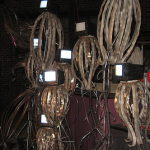
The concept of fusing robot and botany led Jill Coffin to collaborate with John Taylor and Daniel Bauen to create Breeze.
A mature Japanese Maple tree was carefully wired with monofilament down to nitinol (nickel titanium) wires to create silent motion.
A 360-camera hidden in a lantern suspended over the tree was used to detect motion of observers. Computer vision algorithms were used to trigger relays to actuate the the various branches near the motion in the room.
The tree appeared to reach out to people passing by.
In 2006, the annual SXSW music festival was changed forever by a guerilla marketing activation by Red Bull. The beverage company rented a 10,000 square-foot warehouse in downtown Austin during the music festival, performed extensive renovations to bring it up to code, and threw a massive week-long, invite-only party.
The Red Bull House had all the elements now commonplace in SXSW marketing activations, a main stage, a gaming lounge, an internet cafe, a room for DJs, open bars, pool tables, arcade machines, and even a basketball court.
Over half a decade prior to forming LumiGeek, co-founders Joe Martin and John Taylor teamed up to bring amazing interactive technology and art to SXSW. It was undoubtedly the first time that technologies (such as PlayMotion’s stereoscopic computer vision and projection environments) were debuted at the technology mecca.
It was the curation of this event where Martin and Taylor found that they could work together under the pressures of a highly intensive production environment, yet still showcase delicate and cutting-edge technologies.